

Playing with Fire
But, can it still be considered art?

When I was a kid, a pack of matches was the most forbidden fruit. They tumbled down with each pack of Chesterfields mom would send me to the corner gas station to buy for her from a cigarette machine. I’m old enough to confess that she gave me a quarter for the smokes and a nickel to buy myself a candy bar. I pocketed the matches.
To have a pack of matches at ten years old was power. You could impress your friends, take risks, build a fire. Decades later, that same impulse causes me to embrace AI, dance with the devil as some see it. I got my first car and started driving when I was 13. I took “shop” classes in high school. I like power tools.
When I discovered the surrealist AI cinema of Kelly Boesch I was flabbergasted1, utterly astonished at how she managed to build such intense visual and musical storytelling. I began to follow her and pay attention to details.
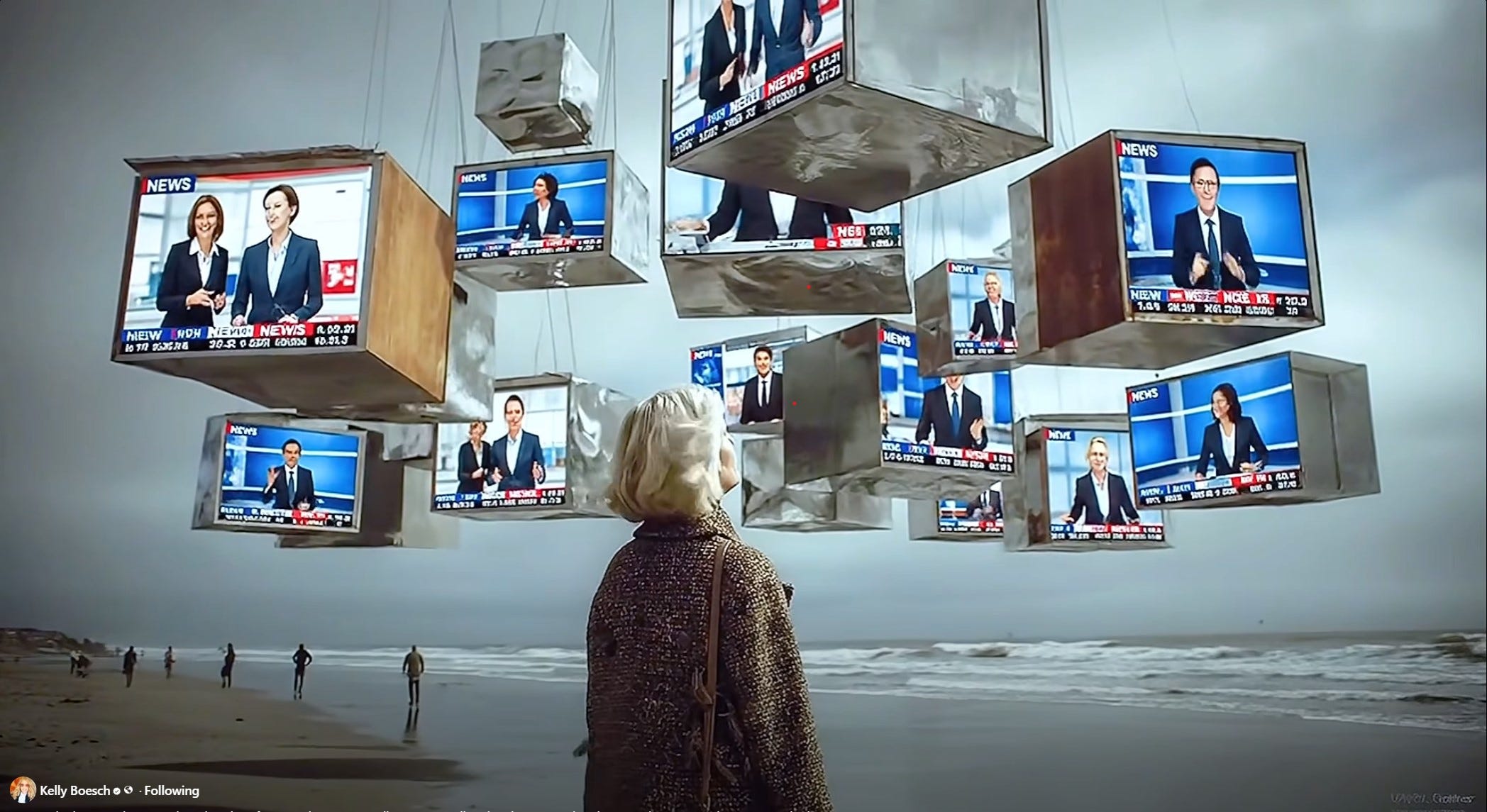
Kelly writes poems and lyrics, takes them to Suno to generate songs. She polishes and perfects them and uses AI to generate video clips that delivcr fascinating tales. I discovered another digital creator Arjuna Noor on Facebook and as I kept digging deeper, the controversy over AI-as-art continued to boil.
How could one of China’s internationally renowned art cinema directors, “the auteur who had so tirelessly championed realism, a sense of authenticity, and an ethical engagement with his subjects, produce a film that felt utterly plastic, mechanical, and soulless,” asks Michael Berry about Jia Zhangke’s foray into AI filmmaking.
“Jia Zhangke’s Dance” took only three days to produce using Seedance 2.0 developed by ByteDance. His AI-generated video portrays a younger version of Jia in a spacesuit seeming to debate with an older version of himself, the actual Jia Zhangke wearing his ever-present sunglasses. Neither of them are real-life actors.
Never one to be deterred by controversy…
I picked up the ball and ran with it. I took one of my poems over to Suno and had it generate ten different versions of my poem as a song. The earliest ones had a man singing and strumming a guitar, way too folky. I selected several more appealing genres and requested a female vocalist until I had two versions that I liked.
I opened my ChatGPT, attached the audio file, and said, “I wrote a poem and then generated the attached song using Suno AI. Can you provide me with some Sora prompts to create a video for it? They should be the same length as the song.”
ChatGPT responded, “Your song length is 189.5 seconds, which is about 3 minutes 9 seconds. That makes it perfect for a short poetic film. The best approach is to build a Sora storyboard that follows the emotional structure of the poem. Below is a timed visual storyboard you can paste into Sora scene by scene.”
I had twelve scene prompts to begin with. Some of the resulting clips that Sora generated needed to be revised so I polished and rewrote the prompts until I had twelve clips that maintained visual continuity and delivered my message. I loaded the clips and the audio into Adobe Premiere where I arranged the cuts and transitions, to essentially finalize “It Takes Faith,” the music video that follows.
It started with a poem I wrote.
The Work of Faith

It cannot be considered effortless.
Faith requires focus.
It often blurs
beneath waves of information.

Thoughts flow in and out
upon clouds of opinion,
anger, fear, and doubt.

But faith takes work.
Like building a fire,
your breath upon a spark of intention.

You must raise a flame
and nurture it alone,
despite the cold indifferent tones
of critics and popular convention.

It takes faith to be yourself.
There is an emerging movement that seeks to label work as “AI-free” in order to be considered legitimate.
…as if the use of new tools diminishes the authenticity of what is created. As if using them somehow removes the human from the process. I’m not denying the existence of AI slop. When cameras first became widely available, we suddenly got piles of bad snapshots and it took years before photography was accepted as an art form. Rap emerged in the 1970s from street corners and block parties in the Bronx, opening doors for raw, lyrical poets like Rakim, Nas, and Tupac who elevated it beyond novelty rhymes into profound storytelling and social commentary.
I understand the concern.
These new tools do have sharp edges.
But refusing them entirely feels to me like insisting a house be built only with hand tools. It is not a defense of craft. It is a rejection of evolution.
The question is not about which tools are used.
The question is whether a human being remains present in the act of creation.
I did not disappear from this process.
I initiated it.
I selected.
I corrected.
I held continuity.
I finished it.
Just when I came to love working with Sora, I found out that OpenAI is discontinuing its development—web and app support will end on April 26, 2026. No problem. There are scores of other power tools available and continually evolving.
OMG! Like David Foster Wallace, I just discovered I can include footnotes with my Substack posts. The earliest known literary use of flabbergasted is from the late 1700s, with the Oxford English Dictionary citing 1784 in Loyola: Novel as its earliest evidence. A related historical note is that the word was already being described as a “new vogue word” by 1772, so it likely circulated before the earliest surviving literary citation.